[Update] The research has been extended to all the countries covered by our Telecom Europe service.
Many European countries now have one or more wholesale-only operators, providing access to their (mainly) fibre networks, while not offering retail services themselves.
Since they do not have their own retail operations, wholesale-only operators are less likely to discriminate against access seekers as they have a strong incentive to provide wholesale access to all in order to maximise the use of their networks. Accordingly, the EECC limits any SMP remedies that can be applied to such operators.
Operators pursuing wholesale-only models are often not traditional telecommunications operators but rather municipalities, public utilities and/or financial private investors.
Download the map that shows which European countries researched have one or more wholesale-only operators
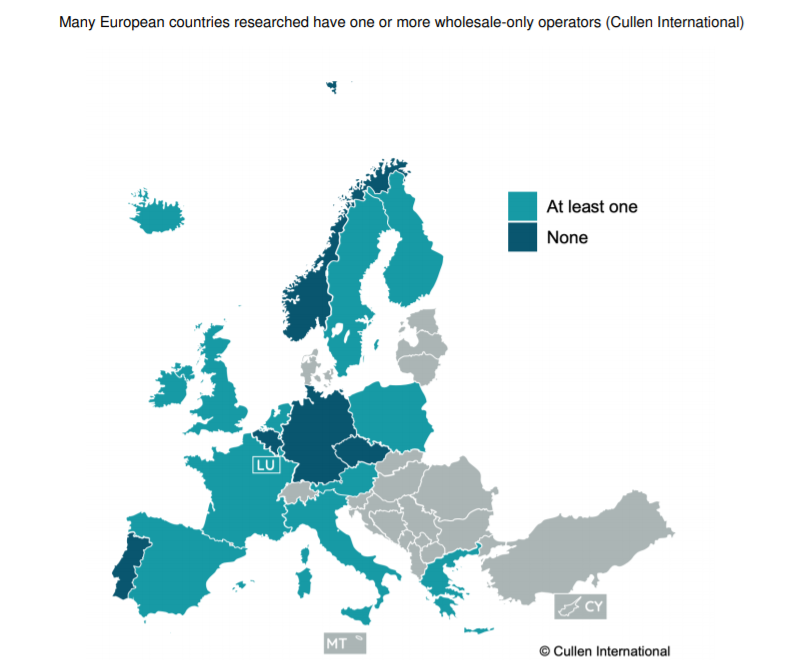
Cullen International just published a new benchmark that summarises the main wholesale-only initiatives for fibre deployment in selected European countries, focussing specifically on:
- the name(s) of any wholesale-only operator(s) in the market;
- the description of the type of business model adopted and product(s) offered;
- the operational launch date;
- information on the key shareholders, e.g. municipalities, public utilities and/or financial investors;
- the geographical scope (national/regional) and the targeted areas (rural/urban/rural and urban); and
- the current and planned coverage in terms of premises passed or connected.
The research focuses on “pure” wholesale-only operators, therefore not including open access networks operators with their own retail customers or legally separated operators.
To access the full benchmark, please click on “Access the full content” - or on “Request Access”, in case you are not subscribed to our European Telecoms service.
more news
12 March 26
National implementation of the EU Gigabit Infrastructure Act
The Gigabit Infrastructure Act (GIA) is a regulation and as such directly applicable in all member states without the need for transposition into national law. Despite being a regulation, the GIA often sets minimum requirements, on top of which member states can adopt additional measures to address country-specific circumstances. Our new benchmark shows the choices made by member states when implementing the GIA.
09 March 26
How are EU member states transposing NIS2?
Our latest benchmark tracks the progress of the Directive on measures for a high common level of cybersecurity across the EU (NIS2) transposition in the 27 EU member states.
05 March 26
CSRD: Austria and Malta finalise national transposition
Cullen International’s latest benchmark tracks the progress made by the 27 EU member states in transposing the Corporate Sustainability Reporting Directive (CSRD) and the related “stop-the-clock” directive.