Four EU member states (Belgium, Estonia, Greece and Poland) recently finalised their national transposition of the Corporate Sustainability Reporting Directive (CSRD).
Nine EU member states are still transposing the Corporate Sustainability Reporting Directive (CSRD), having missed the 6 July 2024 transposition deadline. The Commission has issued formal infringement notice letters to 17 member states for their failure to transpose the CSRD fully.
The CSRD requires all large companies to publish regular reports on their environmental and social impact activities. The directive defines a common reporting framework for non-financial data, which aims to ensure that businesses report reliable and comparable sustainability information.
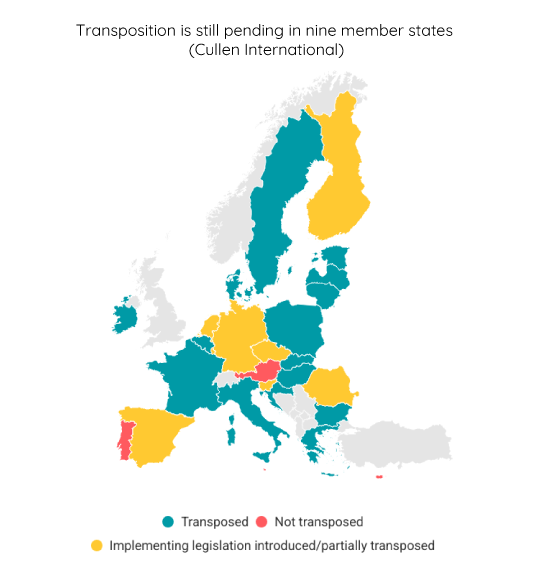
Cullen International’s benchmark tracks the progress made by the 27 EU member states in transposing the CSRD.
For more information on the benchmark and Cullen's complete CSRD coverage, please click on “Access the full content” - or on “Request Access”, in case you are not subscribed to our Sustainability service.
more news
21 September 26
EU Kids Act: EU Commission unveils gradual and differentiated approach to protect children online, including a social media delay
As announced by EU Commissioner Von der Leyen in her State of the Union address, the EU Commission unveiled a gradual and differentiated approach to protect children online, where “each age benefits from a tailored protection level”. Read our full analysis.
18 September 26
EU Timeline: regulatory milestones for the remainder of 2026
This edition of Cullen International’s EU Timeline highlights key policy and regulatory developments foreseen at EU level until the end of 2026.
17 September 26
Electric power backup and other redundancy requirements for telecoms operators across Europe
Our latest European Benchmark explores electric power backup and other redundancy requirements for mobile network operators to ensure service continuity during power outages, natural disasters, and other events impacting the operation of telecoms networks.